
See what your experts' knowledge can become
Get a free demo. A 15-minute chat, fully tailored
to your needs. No commitment.

Updated on
AI in learning and development is no longer an experiment. Most L&D teams now use AI in some form, from generating course drafts and translations to recommending content and automating admin. The question has shifted from whether to use AI to how well you apply it.
Used well, AI in L&D helps teams create training faster, personalise learning at scale, and connect learning to real performance problems. Used poorly, it produces generic content, inconsistent quality, and risks that undermine trust.
In this article, we share the AI skills L&D teams need, four practical use cases for AI in learning and development, and why building your team’s AI application capability is the key to lasting impact.
But first, what’s going wrong with AI today?
Key takeaways
If you’ve given AI a shot but haven’t witnessed the outcomes you’d hoped for, you’re not alone.
We polled The L&D Collective and found that there are three main reasons why L&D teams are not fully embracing AI-based solutions:
All three challenges point to the same root cause: AI is being used without the skills, guardrails, and workflows needed to apply it well.
Luckily, there is one skill that can help you overcome these challenges and concerns over AI.
By providing your contact info, you agree to receive communications from 360Learning. You can opt-out at any time. For details, refer to our Privacy Policy.
For many of us, the challenges we’ve mentioned above stem from a lack of experience in feeding the AI machine. After all, this is a completely new skill that takes time to master.
But great outcomes depend on great inputs. The text, questions, information, or coding that communicates to AI what response we’re looking for has a significant impact on the quality of the output.
That’s why the most important skill is AI literacy. It starts with prompting: knowing how to give AI clear context, instructions, and examples. But it also includes critically reviewing AI output for accuracy and bias, knowing when not to use AI, and working within your organisation’s guardrails.
Together, these skills ensure AI output is relevant, accurate, and aligned with your learning goals.
So, how can you get started with prompt proficiency and use it to leverage AI-based tools as part of your learning strategy? Read on to learn more about how you can use AI as your thought partner to maximise the impact of your learning solutions.
Using artificial intelligence in your L&D strategy in a way that makes a real impact goes beyond chatbots and virtual assistants or ChatGPT content creation—you need more control over these processes.
The optimal AI strategy is to lead with a human approach, call the shots, and maintain complete control over your L&D programmes. And the best way to control AI is to know what to do with it as your co-pilot. Here are four use cases that will set you apart.
As L&D leaders, we can see the benefit of engaging SMEs to share knowledge in our organisations. But SMEs are some of the most in-demand people in the business—the majority of them don’t have the capacity to help. That’s why it’s critical to make the process of sharing knowledge as seamless as possible.
Enter AI-assisted authoring. This approach involves using AI technology to aid in creating and developing learning content.
Firstly, consider investing in a learning platform that has an AI-powered authoring tool. An authoring tool with AI capabilities enables you to confidently empower your subject-matter experts (SMEs) to create learning content with ease and efficiency while maintaining a firm grip on your content strategy.
By leveraging ready-to-use templates or customised prompts, you can decentralise content creation to your SMEs and ensure that employee training meets company requirements and policies such as DEI or compliance.

AI-assisted authoring serves as a dependable co-pilot for SMEs, streamlining the time-consuming process of content creation, making it easy for your experts to share their specialist knowledge. Admin-controlled prompts also allow you to share your pedagogical knowledge effectively with SMEs who are not required to be pedagogical experts to produce new engaging courses.
Sharing and documenting institutional knowledge is key to your company’s growth and reducing business costs.
With AI-assisted authoring, you and your team can turn static documents into engaging, interactive learning experiences that improve user experience and match your training goals and impact employee performance.

In addition, without the need for manual conversions, the course creation process is streamlined. This guarantees that converted courses will maintain the same quality and integrity as the original content, instilling confidence in your work.
With your expert guidance, AI can simplify content creation, transforming minimal information into engaging and complete learning experiences with remarkable efficiency.
Using algorithms that tag skills to eLearning courses or paths helps you organise and make it easier for learners to find the right courses or programs for their learning journey.
AI-powered skill tagging empowers you to leverage your skills metrics quicker and easier through a self-assessment workflow that recommends skills to learners based on any data coming from your HRIS.

Learners are prompted to provide their job title during onboarding, and the skill-driven recommendations kick in. As learners change roles or update their job titles, the skill-driven recommendations automatically update, ensuring the suggested content remains relevant, while reducing the L&D team’s time spent on manual updates.
A streamlined self-assessment workflow ensures the recommended content is tailored to each learner's role and individual needs. So, by leveraging AI-powered skill tagging, you can enhance the learning process and deliver a personalised learning journey that accelerates upskilling based on learners' skills data.
Upskilling from within helps fill knowledge gaps, impact employee performance and capability, and boost employee retention. And you guessed it; you can accelerate your upskilling initiatives by utilising artificial intelligence.
Using AI-powered training recommendations, you can generate personalised course catalogues instantly. The algorithm creates relevant groups and content based on the learner’s job title and associated skills. This allows you to create a catalogue from various trusted sources for the most up-to-date training materials.
For example, 360Learning’s platform handles the heavy lifting by analysing learners' job titles and creating relevant subgroups, allowing you to deliver personalised training materials tailored to individual needs and skills––and removing the need for manual group customisation.
With 360Learning’s AI Companion, this capability goes even further to maximise learning content ROI: its Search Mode allows learners and L&D teams to quickly find the exact content or knowledge they need, tapping into both formal courses and insights shared by colleagues. Beyond Search Mode, the AI Companion is designed as an intelligent partner that helps streamline workflow automation and support strategic decision-making, helping your team focus less on manual tasks and more on high-impact upskilling initiatives.

Knowledge alone doesn’t change performance; practice does. AI roleplay lets employees rehearse real conversations, such as sales calls, customer complaints, or difficult feedback discussions, with AI personas that respond realistically.
With 360Learning’s AI Roleplay, learners practise in a safe environment and receive instant, personalised feedback, while L&D teams and managers can see where people need more support. It’s a clear example of AI moving beyond content production to improve performance in the flow of work.
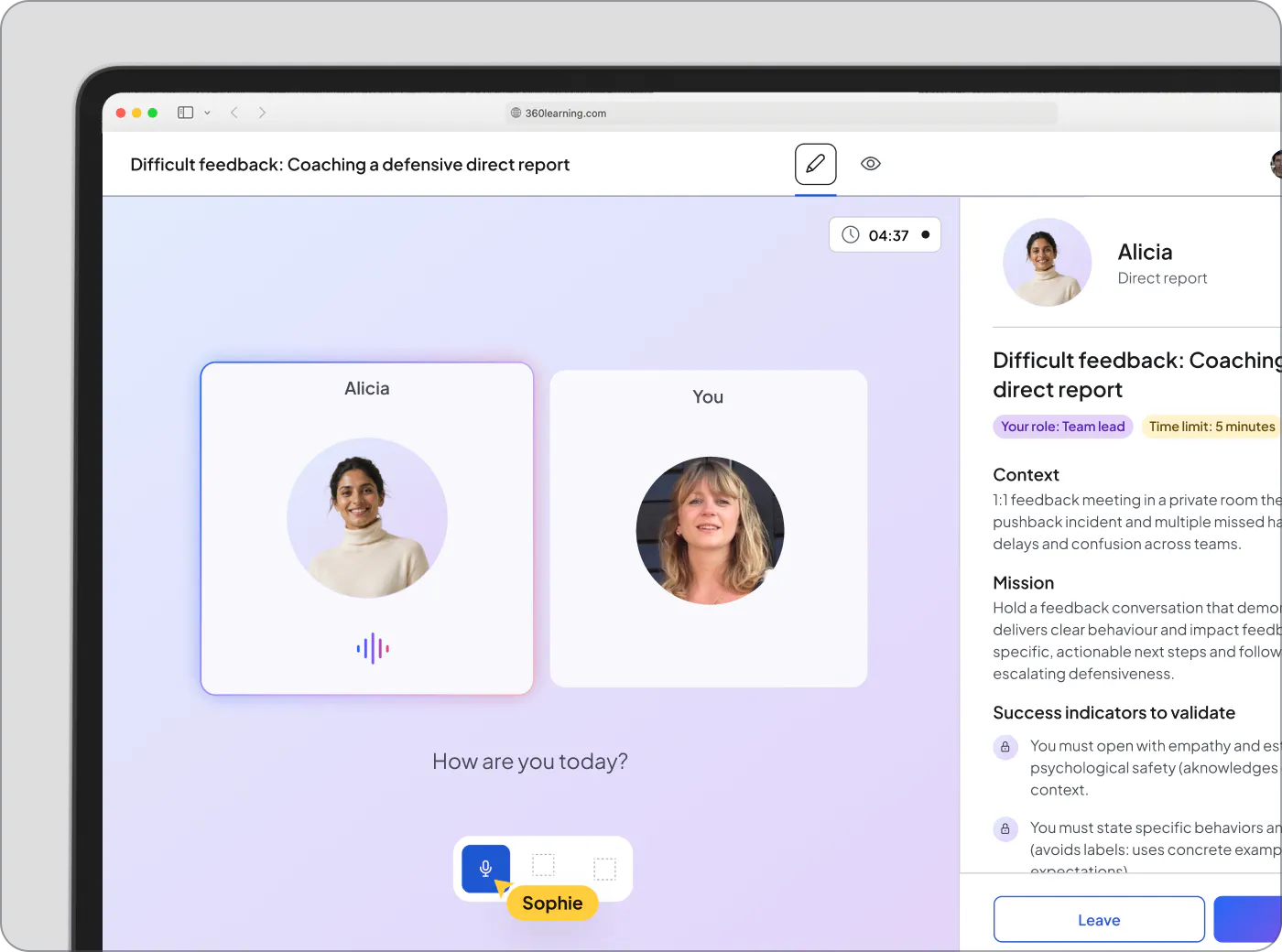
That practice pays off in real like. Employees simulate tricky situations in a safe, supportive environment. Then when they meet the same circumstances for real, they're confident and prepared to handle them head on.
“I practiced a challenging scenario using AI Roleplay. Just one month later, I found myself in the exact same situation in real life. Because I had already run the simulation, I knew exactly what to do.”
Buying AI-powered tools is the easy part. The real gap for most organisations is AI application: knowing how to use AI deliberately, safely, and in ways that actually solve business problems. Without it, AI use stays scattered across individuals, outputs are inconsistent, and the value never scales beyond a few enthusiasts.
AI application is one of the nine themes in our L&D Maturity Model. It assesses how AI is adopted across your L&D function, how guardrails and workflows are managed, and how AI elevates learning interventions to solve business challenges.
Most L&D functions sit somewhere along this path:
Moving up these levels isn’t about adopting more tools. It’s about building the skills, habits, and governance that let your people apply AI with confidence.
Want to see where your L&D function stands today? Take the L&D Maturity Model self-assessment to benchmark your AI application, along with eight other themes, and get resources to help you level up.

By providing your contact info, you agree to receive communications from 360Learning. You can opt-out at any time. For details, refer to our Privacy Policy.
AI in learning and development delivers real impact when it’s applied deliberately: with clear guardrails, skilled teams, and a focus on the business problems that matter most. Used this way, AI doesn’t replace the human side of learning. It amplifies it, freeing L&D teams from manual work so they can spend more time bringing experts and peers together to share knowledge and improve performance.
But building that capability is much easier on a platform designed for it. 360Learning is the AI-driven LMS built for enterprise upskilling. Ranked the #1 AI-powered LMS by eLearning Industry, it brings AI into every stage of the learning cycle:
And because it all happens natively in one platform, you get a single view of learning, skills, and performance across your organisation, without juggling separate AI tools.
Book a demo to see how 360Learning can help you put AI to work for your upskilling strategy.
"Buyers are demanding to see real agentic capabilities, not just AI content generation dressed up with new vocabulary. 360Learning’s action mode and conversational simulation pipeline represents a genuine attempt to operationalize AI within L&D workflows rather than layer it on top of them."
- David Wentworth, Managing Director of Learning and Talent, Brandon Hall Group
Get a free demo. A 15-minute chat, fully tailored
to your needs. No commitment.
By providing your contact info, you agree to receive communications from 360Learning. You can opt-out at any time. For details, refer to our Privacy Policy.
What is AI in learning and development?
How should L&D teams get started with AI?
What are the risks of using AI in L&D?
Will AI replace L&D professionals?
 Our weekly newsletter of the best insights from L&D peer to L&D peer.
By providing your contact info, you agree to receive communications from 360Learning. You can opt-out at any time. For details, refer to our Privacy Policy.


