
See what your experts' knowledge can become
Get a free demo. A 15-minute chat, fully tailored
to your needs. No commitment.

Updated on
Definition: Gamification training is the use of game elements, such as points, badges, leaderboards, challenges, and storytelling to make employee learning more engaging and motivating.
Gamified training adds game mechanics to your existing courses and programs to encourage participation, practice, and progress.
And it works. A meta-analysis published in Educational Psychology Review found that gamification has small but significant positive effects on what people learn, how motivated they are, and how they behave. The same research found that two design choices made gamification especially effective at changing behavior: adding a story, and combining competition with collaboration.
In this guide, we’ll explain the two types of gamification that L&D teams find most successful, share 12 gamification ideas for training, and show you what to look for in gamification training software.
Key takeaways
Gamification training applies game design elements to workplace learning to motivate employees to start, continue, and complete their training. The learning content stays the same; what changes is the experience around it.
For example, instead of asking new sales reps to read a product guide, you could turn product training into a series of short challenges. Reps earn points for each quiz they pass, unlock a badge when they complete a product line, and see their progress on a team leaderboard. They still learn the same product knowledge, but they’re more likely to finish, come back, and remember it.
Common elements of gamified training include:
The two terms are often used interchangeably, but they mean different things:
Most organizations start with gamification because it’s quicker to implement. Game-based learning is worth the extra investment for high-stakes skills that need realistic practice.
There’s no one-size-fits-all approach to gamifying your employee training programs. You need to take into consideration your team’s goals and your learners’ needs when deciding whether to gamify your training’s content or to incentivize employee performance.
You can also combine both types. Here’s how one company did it.
Zotec Partners took its standard compliance training and turned it into an interactive, reward-based escape room experience, combining content gamification (a story-driven challenge) with performance gamification (rewards for progress).
The key to success was asking employees what kind of training they’d find most meaningful before designing it. The results:
Content gamification happens when the training materials themselves are gamified. This can be particularly useful when you already have rock-solid content in place and need a way to make it more engaging for your learners.
There are many different ways to add game-like elements to content, but storytelling, challenges, and simulations are most common. For example, rather than jumping straight into the training’s lessons and objectives, lead with a compelling story to keep your learners interested in the training.
As counterproductive as it may sound, make room in your content for learners to fail by letting them take assessments more than once. As gamification expert Karl Kapp explains in The Gamification of Learning and Instruction, the freedom to fail is often more rewarding for learners because it gives them a chance to take risks with their decisions and learn from their mistakes.
The freedom to fail is often more rewarding for learners because it gives them an opportunity to take chances with their decision-making.
Performance gamification, or structural gamification, occurs when the system around the content is gamified. Think about it as the wrapper that surrounds your content by adding incentives to keep the motivation to learn high.
Unlike content gamification, the purpose of performance gamification is to guide users through their learning journey, motivating them at key moments to keep them engaged. For example, if you know learner engagement drops about halfway through onboarding training, that’s a great moment to implement a motivational message, give words of encouragement, or reward employees for the work they’ve done thus far.
The reason why performance gamification works is it taps into our human need for reward. The Incentive Theory of Motivation suggests that, as humans, we’re driven by our desire for external validation. The theory holds true in a workplace setting: Achievers Workforce Institute research shows that when employees report that they are recognized at least monthly, they are also more likely than average to be engaged, committed, and productive at work.
One common way to incorporate performance gamification into your training program is to make use of scoring elements, like levels, points, or leaderboards, to engage competition-driven employees.
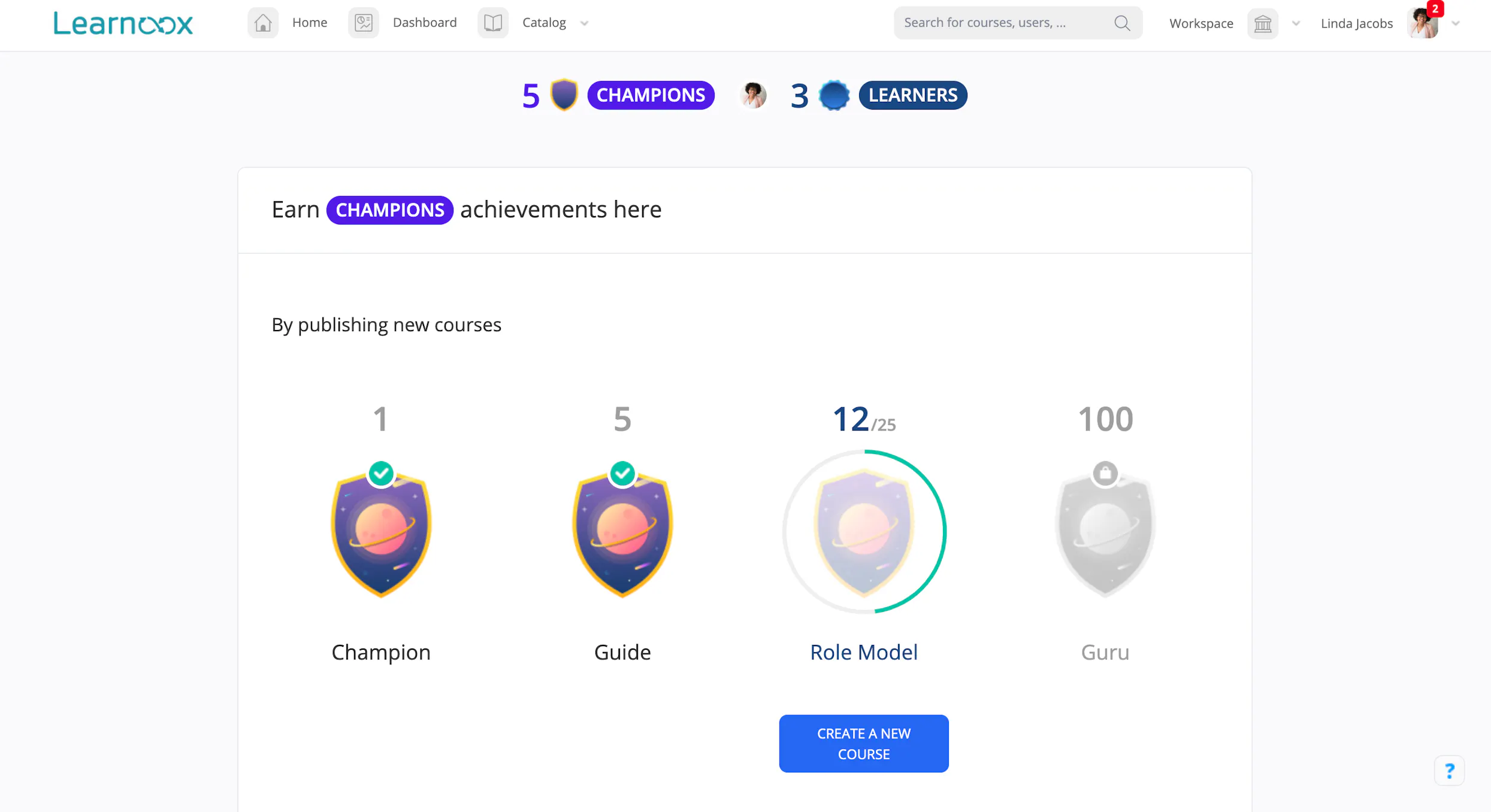
The 360Learning LMS includes achievements and leaderboards that celebrate learner wins by ranking and recognizing those who excel. And with mobile learning built in, employees can access gamified training wherever they work.
Looking for inspiration? Here are 12 gamification ideas for training, grouped by use case. Each one works with the content and tools you already have.
Start with completion and engagement, but don’t stop there. The real test of gamification is whether people perform better at work.
AI is opening up a new kind of gamified training: scored practice. With AI role-play, employees practice realistic conversations, like a sales pitch, a difficult customer call, or a performance review, with an AI persona that responds like a real person. Each attempt gets a score and instant feedback, and learners can retry as many times as they like to beat their best score.
This combines the motivation of a game (scores, retries, visible improvement) with real skill-building, in a safe space where mistakes don’t cost a customer or a colleague. Tools like 360Learning's AI Roleplay make it possible to scale this kind of practice across entire teams.
You don’t need a platform with every gamification feature to succeed. But the right gamification training software makes it easy to add game elements to your courses, scale them across teams, and see what’s working. Look for:
360Learning combines gamification with collaborative learning. Learners earn achievements, climb leaderboards, and practice skills with AI Roleplay, while subject-matter experts create courses quickly with AI-assisted authoring. Because learners can react to and discuss every course, training stays engaging, social, and easy to improve.
Gamification training works best when it serves a clear learning goal. Start small: add a story to a course, run a team challenge, or let learners retry a scenario until they master it. Then measure what changes and build from there.
The most effective gamified training combines a little competition with a lot of collaboration, and it rewards real skills, not just clicks. With the right approach and the right software, you can turn training employees put off into training they come back to.
Get a free demo. A 15-minute chat, fully tailored
to your needs. No commitment.
By providing your contact info, you agree to receive communications from 360Learning. You can opt-out at any time. For details, refer to our Privacy Policy.
What are examples of gamified training?
Does gamification improve training outcomes?
Is gamification effective for compliance training?
What is the best gamification training software?
Can gamification be used for remote or frontline teams?
 Our weekly newsletter of the best insights from L&D peer to L&D peer.
By providing your contact info, you agree to receive communications from 360Learning. You can opt-out at any time. For details, refer to our Privacy Policy.