
L&D Strategy Roadmap: 9 Focus Areas That Determine Learning Success

Updated on
Not all L&D programs are created equal. Some professionals find themselves stuck as service providers, responding to stakeholders requests with little input or focus on the future. Others are deeply embedded in business strategy and culture, developing the skills and knowledge that will help their organizations adapt and thrive.
Some are strategic, while some deliver what’s required. Some are forward-looking, and others are purely reactive.
To help you understand where your strategy stands—and where it can go—this article introduces an L&D maturity model that outlines the progression from foundational to advanced learning practices.
We then use this model to assess your L&D approach across nine critical dimensions:
- Learning strategy
- Leadership alignment
- SME collaboration
- Learner engagement
- Learning needs identification
- Training processes
- Learning metrics
- AI application
- Line manager involvement
Whether you're building your L&D function from the ground up or looking to elevate an existing function, this model provides a clear framework to guide your next steps. You’ll identify gaps, set priorities, and chart a path toward a more impactful and future-ready learning strategy.

How mature is your L&D function?
By providing your contact info, you agree to receive communications from 360Learning. You can opt-out at any time. For details, refer to our Privacy Policy.
The 5 levels of L&D strategy maturity
We’ll explore each focus area through the lens of the 360Learning Maturity Model. It maps your strategy along five levels of progression, from foundational practices to more advanced, business-driving approaches.
This isn’t about passing judgment—it’s about helping you move forward with confidence and clarity, no matter where you start.
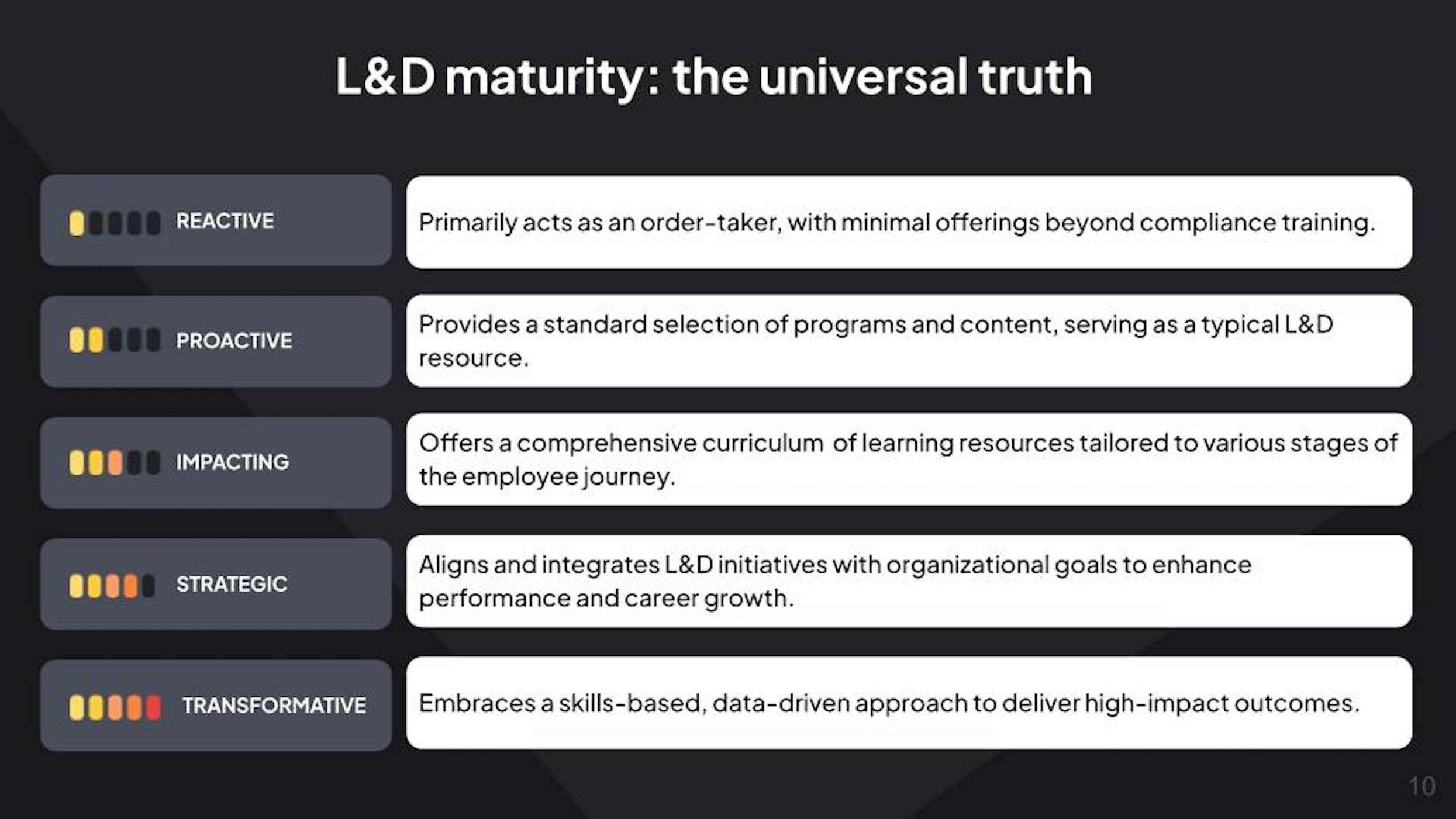
The model has five levels:
- Reactive: Can feel like an order taker, with minimal offerings beyond compliance training.
- Proactive: Provides a standard selection of programs and content, serving as a typical L&D resource.
- Impacting: Offers a comprehensive curriculum of learning resources tailored to various stages of the employee journey.
- Strategic: Aligns and integrates L&D initiatives with organizational goals to enhance performance and career growth.
- Transformative: Embraces a skills-based, data-driven approach to deliver high-impact outcomes.
Many corporate learning teams operate in the first three levels. Most new L&D teams find themselves moving from request to request, with little opportunity to think or act strategically. Given time, some build impressive, comprehensive content libraries and curriculums, and can tackle multiple company needs—compliance, onboarding, management training—admirably.
But the goal isn’t to build the biggest content library, hoping there’s something for everyone. The goal should be a Learning and Development strategy closely aligned with the most pressing organizational goals. And eventually, one that anticipates future needs and propels you towards the organization of the future. The “Transformative” level may always be a stretch goal, but it’s worth striving for.
Let’s turn now towards the key aspects or themes of any good L&D strategy. For each, we’ll briefly examine what maturity looks like, and how you can evolve your own strategy
To assess your existing L&D strategy and approach, try our maturity model for yourself.
9 key themes for your L&D strategy roadmap
Whether you’re building a new strategy roadmap from scratch, or want to assess and update your existing approach, look closely at the following nine key factors.
1. Learning strategy
Most L&D strategies begin with and center around their learning content—the areas in which you need team members to develop. What do we need to train people on?
We’ll look at the most common use cases shortly, and how they can indicate the level of sophistication within your L&D function.
But it’s not just the use cases themselves that dictate maturity—how learning needs are identified, and by whom, is critical. Mature learning strategies build performance-driven programs in response to core business needs, and with an eye on the future. More basic strategies create courses almost entirely from ad hoc stakeholder requests, or fill their libraries with generic off-the-shelf content.
Typical learning use cases
Relatively new or underdeveloped strategies will focus on a few classic learning paths. As time goes by, you’ll build out new ones and construct a comprehensive learning library.
Learning strategy usually begins with the following core use cases:
- Compliance
- Global onboarding
- Employee and leadership development
As learning strategy evolves, more business-focused use cases emerge:
- Sales enablement
- Partner/customer training
- Field training
- Software training
- Functional onboarding
When learning strategy is truly mature, it will also address at least one skills-based use case:
- Leadership model
- Functional upskilling
- Functional reskilling
As you design your L&D strategy, each of these use cases has an impact on its maturity. That sounds a bit vague and esoteric, so here’s what it looks like in practice.
The maturity levels of learning content strategy
Going back to our five levels above, here’s what each looks like when applied to your learning content strategy.
Reactive
Informal strategy: lacks formal definition; usually revolves around a single primary learning need, and functions as a request-and-response model led by L&D.
- Typically covers one core use case (usually compliance)
Proactive
Generic strategy: established within the L&D function; seeks to address all foundational learning needs but excludes business-specific objectives, aiming to maintain current operational levels.
- Typically covers 1–3 core use cases
Impacting
Employee-oriented strategy: guided by the L&D function to support essential learning needs, while individual business units identify tailored learning goals to enhance team performance and development.
- Typically covers 1–3 core use cases and 1-3 business use cases
Strategic
Business-oriented strategy: HR and L&D approaches are deliberately coordinated with the broader business strategy, focusing equally on foundational and business-driven learning priorities to advance key strategic goals.
- Typically covers all three core use cases, and at least three business use cases
Transformative
Skills-based learning strategy: formulated at the organizational level; incorporates foundational, business-specific, and skill-centric learning goals, with the intent to strengthen workforce adaptability, preparedness, and career movement.
- Typically covers all three core use cases, 3+ business use cases, and at least one skills use case
If you’re building your content strategy from scratch, we’re not suggesting you tackle (at least) seven use cases at once. But as you build out your curriculum, you should orient around key business objectives, and ideally take a skills-based approach from the outset.
2. Leadership alignment
Learning and Development is, in many ways, a service provider in an organization. But that’s not all it should be. To have maximum impact as a department, you’re going to need executive buy-in and empowerment.
And because that won’t just happen by accident, you should factor it into your strategy. Determine the internal stakeholders your L&D function aligns with most frequently (and strongest), assess how organizational leadership perceives L&D today, and set clear expectations for how often you’ll meet with senior leaders.
In fact, we can use meeting frequency as a fairly clear indicator of alignment. Here’s how this looks in our maturity model:
Reactive
L&D is merely seen as a cost center, and there’s no meaningful alignment between L&D and leadership.
- KPI: Leadership does not meet with L&D
Proactive
Leadership views L&D as a support function, but not a strategic business partner.
- KPI: Ad-hoc meetings between L&D and leadership
Impacting
Some business leaders partner with L&D on training needs and use cases.
- KPI: Yearly meeting between L&D and business leadership
Strategic
All executive leaders see L&D as a strategic business partner, and help to identify key training initiatives.
- KPI: Quarterly meetings between L&D and business leadership
Transformative
Leadership depends on L&D to enhance business performance by continuously developing employee skills. The function is highly valued and receives strong organizational support.
- KPI: Monthly meetings between L&D and business leadership
3. Subject-matter expert collaboration
How you engage and deploy internal subject-matter experts (SMEs) in your L&D initiatives is a critical indicator of its maturity, and ultimately your success. They’re your organization’s secret sauce—holders of immense institutional knowledge and the best placed to pass on proprietary skills to teammates.
SME authorship is also typically the element that separates generic, off-the-shelf content from the original courses that speak specifically to your teams.
If you want your L&D strategy to rise above the baseline, you need SMEs involved. As our maturity levels show, the more course material created or edited by your own experts, the better.
Reactive
Internal subject-matter experts contribute informally, but the organization lacks visibility into who they are.
- KPI: 0% of courses created with SMEs
Proactive
L&D has limited awareness of internal experts and typically engages them only for top-down learning programs.
- KPI: <5% of courses created with SMEs
Impacting
Efforts to involve internal SMEs in content creation are underway, though not yet structured or consistent.
- KPI: 5–25% courses created with SMEs
Strategic
L&D has implemented a clear process to identify, work with, and recognize internal SMEs who contribute to course development.
- KPI: 25–50% courses created with SMEs
Transformative
Collaborating with SMEs is a core component of the L&D approach, and these experts are essential partners in reskilling and upskilling efforts.
- KPI: >50% courses created with SMEs
4. Learner engagement
L&D is commonly viewed as a tool to increase employee engagement at work. And its success as an endeavor is also measured by how engaged employees are in learning programs, platform, and content.
As we’ll see, there are two key ways to measure and monitor engagement:
- Whether courses are developed with employee input
- Your ratio of active versus inactive learners
Your L&D strategy should encourage both facets, with a particular focus on the types of learning they participate in, and how much they value the role L&D plays in their growth and performance.
Reactive
Employees are unaware of the organization's learning strategy, resulting in low participation.
- Training is typically top-down
- KPI: <10% monthly active learners
Proactive
Training engagement varies. Most employees only complete required courses without seeking additional learning opportunities.
- Training is typically top-down, with off-the-shelf content
- KPI: 10–20% monthly active learners
Impacting
Learners are actively involved in training related to core functions, business goals, and technical growth. Many voluntarily access the platform to pursue further development.
- Training is mostly top-down, with some bespoke content and some SME support
- KPI: 20–30% monthly active learners
Strategic
Engagement levels are strong and steady. Each employee has a tailored learning plan, learning happens organically within their workday, and the value of training is clearly recognized.
- Training is targeted, relevant, personalized, self-directed, SME-supported, and focused on current business problems.
- KPI: 30–40% monthly active learners
Transformative
A culture of learning permeates the organization. Continuous development is embedded in daily routines, and learners view L&D as a key contributor to their performance, growth, and career advancement.
- Training is targeted, relevant, personalized, self-directed, SME-supported, and focused on current and future business problems.
- KPI: >40% monthly active learners
5. Learning needs identification
Good learning programs are built for and tailored to your organization’s specific needs. Which means you can’t simply follow a playbook—you must actively identify skills gaps and pressing performance and capability needs.
As you craft your strategy, consider how you’ll surface ideas for new courses and materials. Will this be entirely up to leadership, or will you solicit input from across the organization? Will you seek and respond to business and people data? And crucially, what criteria will determine prioritization?
The most advanced L&D departments can efficiently gather ideas and prioritize them based on the true needs of the organization—not on hierarchy.
Reactive
There is no formal process for discovering training needs. L&D mostly delivers compliance training and occasionally fulfills requests from senior leadership or business unit heads.
- Learning needs are prioritized based on the seniority of the person making the request
- KPI: 0% training based on peer-based learning needs
Proactive
Learning needs are occasionally gathered from leadership and managers, with additional one-off requests coming from employees.
- Learning needs are prioritized based on the seniority of the person making the request
- KPI: 0–10% training based on peer-based learning needs
Impacting
A repeatable process exists for collecting input from leaders, managers, and employees to inform learning priorities.
- Learning needs are prioritized based on L&D resources
- KPI: 10–20% training based on peer-based learning needs
Strategic
L&D partners directly with executives, business leaders, and staff to identify training needs and clarify goals. A transparent list of learning priorities is maintained.
- Learning needs are prioritized based on expected business impact
- KPI: 20–30% training based on peer-based learning needs
Transformative
Learning needs are determined based on business goals, performance metrics, career development, and skill gaps.
- Learning needs are prioritized based on organizational priorities, existing skills gaps, workforce development
- KPI: >30% training based on peer-based learning needs
6. Training processes and tools
Next, think about the most operational aspects of your L&D program. Assess how you produce and fulfill training requests, the types of L&D technology you have to support you, and how you leverage AI, automation, and internal SMEs in your workflows.
Good tooling offers much more than interactivity in courses or fun challenges. And AI is rapidly reshaping the possibilities for L&D professionals, supercharging everything from ideation, to authoring, to analysis.
Ideally, you’ll be able to automate a huge amount of the admin associated with course assignment, reassignments, chasing, and escalations. Which means faster rollout, more unique material, and much better reporting.
Here’s what your tools can tell you about your overall L&D maturity.
Reactive
There’s no centralized learning system in place. Training is handled manually by individual departments, limited to SCORM-based content, and lacks any integration of AI into the broader learning strategy.
- 0% of manual L&D tasks are automated, and AI is not used
- KPI: No LMS to support L&D
Proactive
Training is delivered through a one-size-fits-all external vendor. Processes remain largely manual, and AI is occasionally used to assist with course creation on a limited basis.
- <25% of manual L&D tasks automated, <10% of courses are created with AI
- KPI: Standard LMS
Impacting
A single system is used to manage training and track learning data, but functions like enrollment, renewals, and certification tracking still require manual effort. Training includes both off-the-shelf and SME-developed content, with AI used sporadically for ideation or experimentation.
- >50% of manual L&D tasks automated; >30% of courses are created with AI
- KPI: Standard LMS with Academies capabilities
Strategic
The majority of learning is delivered in cohorts through a platform that combines LMS and LXP features, with SME involvement in authoring. Most administrative tasks are automated, and AI supports personalized learning integrated into employees' daily workflows.
- >75% of manual L&D tasks automated; >60% of courses are created with AI; AI is used to build out and maintain skills data
- KPI: Learning platform with LMS, LXP, and Academies capabilities
Transformative
A unified platform with LMS, LXP, and skills intelligence capabilities drives all aspects of training. Content is highly customized, developed in collaboration with SMEs, and aligned to business context. Nearly all administrative work is automated, while AI plays a critical role in surfacing skill insights, managing content libraries, and enriching learner experiences.
- >95% of manual L&D tasks automated; >70% of courses are created with AI; AI is used to build out and maintain skills data, identify and close skills gaps, and analyze talent data and workforce trends
- KPI: Learning platform with LMS, LXP, Academies, and Skills capabilities
7. Learning metrics
Critical to any strategy is knowing how you’ll recognize success. For Learning and Development, we’ve seen a recent move away from basic vanity metrics, to much deeper alignment with organizational objectives and KPIs.
You don’t just need to show that people are completing and enjoying your courses. You need to prove the real impact you have on critical business goals.
The types of learning metrics you track, the insight they provide into business impact, and the extent to which you measure skills data are all central to your program’s maturity.
Reactive
L&D expenditure metrics are tracked, but nothing else is.
- You only measure L&D costs.
Proactive
Engagement metrics are tracked, but there’s no insight into training relevance or business impact.
- You measure costs plus attendance, course completion, Happy sheets, and eNPS.
Impacting
Relevance metrics are tracked, but there’s little-to-no insight into business impact.
- You measure everything above, plus training relevance.
Strategic
Business metrics are tracked, but there’s little-to-no insight into organizational readiness.
- You measure everything above, plus impact on certain business initiatives, and conduct talent mapping for key departments
Business initiatives could include reducing employee turnover, shortening the sales cycle, or even top-line revenue growth (if directly linked to training).
Transformative
Organizational readiness metrics are tracked—at scale—based on skills data.
- You measure everything in Strategic, plus skill readiness of the workforce, the average time to close skills gaps, and the percentage of open internal roles filled by internal candidates
8. AI application
AI is changing what’s possible in L&D faster than any technology before it. But simply having access to AI tools doesn’t make an L&D function mature. What matters is how deliberately AI is adopted, how it’s governed, and whether it’s used to solve real business problems, not just to produce more content faster.
This theme assesses how AI is adopted across your L&D function, how guardrails and workflows are managed, and how AI elevates learning interventions to solve business challenges. At the lower levels, AI use is informal or limited to content production. At the higher levels, AI works across connected workflows, and eventually autonomous agents handle complex, multi-step tasks like skills mapping and gap detection.
Reactive
AI use is ad-hoc, uncoordinated, or absent entirely, with no policy or oversight.
- KPI: 0 approved AI tools and 0 usage-monitoring mechanisms
Proactive
AI drives standard content production and platform recommendations within basic guardrails.
- KPI: Approved tools, 1–2 use cases (content creation, skills-based suggestions)
Impacting
Rather than just content production, AI is employed to solve specific business and performance issues, often in the flow of work itself.
- KPI: 1–3 business-focused use cases deployed
Strategic
AI operates across connected workflows like adaptive pathways, immersive experiences, and admin automation.
- KPI: 3 agentic workflows (adaptive paths, admin automations, simulations)
Transformative
Autonomous AI agents continuously handle multi-step tasks like skills mapping, gap detection, and adaptive learning.
- KPI: 3 autonomous agents (skills mapping, gap detection, adaptive learning)
Moving up this theme isn’t about adopting every new tool. Start by putting clear guardrails and an approved toolset in place, then focus each new AI use case on a specific business or performance problem.
9. Line manager involvement
Line managers have more influence on whether learning sticks than anyone else in the organization. They decide whether employees get time to learn, whether new skills are put into practice, and whether development comes up in day-to-day conversations. Without them, even the best-designed programs struggle to change behavior.
This theme assesses how line managers participate in employee growth, how actively they reinforce learning initiatives, and how far they own skill assessments and team development. In less mature functions, managers simply approve training requests. In the most mature, they co-own skill assessments and development conversations with their teams.
Reactive
Line managers approve training requests, but follow-up is unlikely beyond any informal conversation.
- KPI: 0 manager involvement beyond approving training
Proactive
L&D requests manager support to help reinforce formal learning programs.
- KPI: <25% of managers supporting L&D in reinforcing training
Impacting
Line managers support business-focused programs, although it’s still difficult to prove any impact.
- KPI: 25–50% of managers supporting L&D in reinforcing training
Strategic
L&D partners with managers as co-executors of business-aligned solutions.
- KPI: >50% of managers are strategic partners and reinforce training
Transformative
Managers take co-ownership (with employees) of skill assessments and their team development conversations.
- KPI: >75% manager ownership of skill assessments and development conversations
To move up this theme, give managers what they need to support learning: visibility into their team’s progress, simple ways to reinforce training on the job, and a clear role in setting development goals.
Great L&D strategy: from order taker to performance driver
L&D leaders have a critical opportunity and responsibility to move beyond reactive, order-taking roles and become true enablers of business performance.
Using the principles of our maturity model to assess and evolve your strategy across all nine dimensions, from learning strategy and SME collaboration to AI application and line manager involvement, you can shift from simply delivering training to driving measurable impact.
Strategic planning, proactive collaboration, and a focus on outcomes will position L&D as a core partner in organizational growth.
The more intentional and aligned your approach, the more value you’ll create—not just for learners, but for the business as a whole.
Want to see how your L&D program stacks up? Try our maturity model.
How mature is your L&D function?
By providing your contact info, you agree to receive communications from 360Learning. You can opt-out at any time. For details, refer to our Privacy Policy.
L&D strategy roadmap FAQs
What is an L&D strategy roadmap?
How do I find out my L&D maturity level?
Can my L&D function be at different maturity levels for different themes?
Which theme should I focus on first?
How long does it take to move up a maturity level?
Why were AI application and line manager involvement added to the Maturity Model?


 Our weekly newsletter of the best insights from L&D peer to L&D peer.
By providing your contact info, you agree to receive communications from 360Learning. You can opt-out at any time. For details, refer to our Privacy Policy.